
 Premium−70%
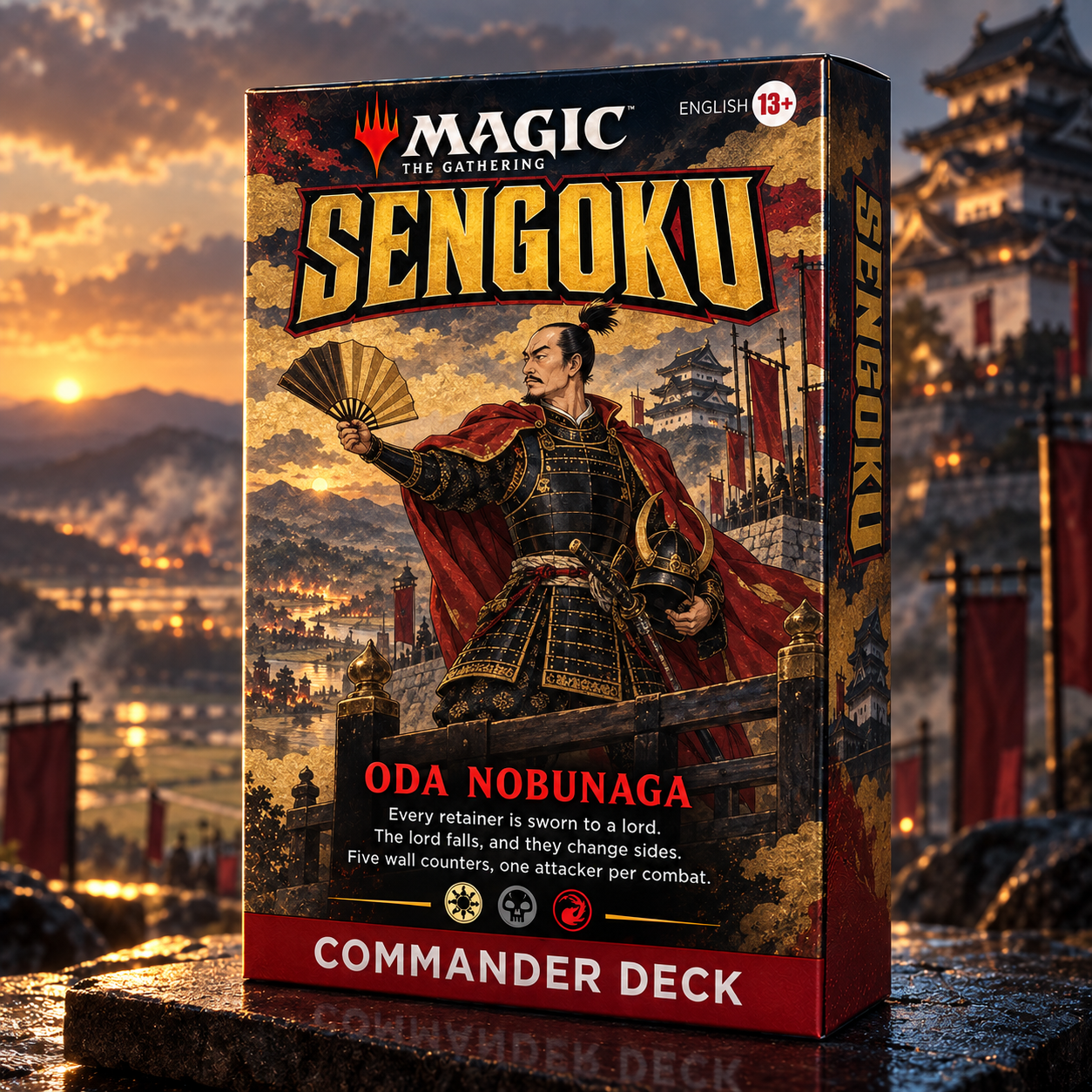
Sengoku — 100-Card Commander Deck
SKU DECK-SNG-100
Oda Nobunaga swears your creatures to a Lord; when that Lord dies, the whole retinue walks to whoever controls the strongest legend at the table. Castle lands let only one attacker through at a time — until the walls come down.
Sengoku — The Oath of Vassals
Commanded by Oda Nobunaga, Tenka Fubu, this Mardu (white/black/red) 100-Card Commander Deck is not a samurai film. It is the accounting of Japan's warring century: a muster roll, a rice register, a hostage handed over as security, and a general who changes sides at noon because the arithmetic changed at eleven. Nobunaga's power is the number of creatures sworn to him, so every army that walks his way makes him harder to displace.
- Vassals: as a creature enters it is sworn to a legendary creature you control — its Lord. When the Lord dies, the creature goes to the player who controls the legend with the greatest power. Nobody chooses and nobody pays: a Lord falls and an entire army changes hands at once. It is more dangerous to you than to anyone, which is why the deck spends as many cards guarding its Lords as killing everyone else's — and why Nōhime, who catches the sworn when a legend dies, is its second most important card.
- The Castle: a Castle land enters with five wall counters, and while one remains you can't be attacked by more than one creature each combat. Every attacker tears a course of stone off, whether it gets through or not. The deck's draw engines spend those counters too: your defence and your cards are the same pile of stones.
- Two combos: Thirteen Days (Akechi Mitsuhide, Oda Nobunaga and The Rice Storehouse) and Odawara Was Not Stormed, It Was Bought (Hōjō Ujiyasu, Kuroda Kanbei and Ishida Mitsunari on four Castles).
Why Mardu
White is the institution, and in this century that means paperwork: court ranks, the sworn oath, the land survey. Black is the security deposit — hostages, poison, the Iga men paid to walk into a keep at night. Red is the campaign season, three thousand matchlocks at Nagashino. Twenty-one cards print Vassals word for word, four Castles hold the walls, and twenty-one legendary creatures compete to be the strongest Lord.
A complete 100-card Commander deck plus 5 tokens, tuned for Bracket 4, available as a digital print-yourself edition or a printed physical deck, and offered in 10 languages.
Fan-made proxy — not intended for official tournaments
Sengoku — 100-Card Commander Deck
Oda Nobunaga swears your creatures to a Lord; when that Lord dies, the whole retinue walks to whoever controls the strongest legend at the table. Castle lands let only one attacker through at a time — until the walls come down.
Quantity
Sengoku — The Oath of Vassals
Commanded by Oda Nobunaga, Tenka Fubu, this Mardu (white/black/red) 100-Card Commander Deck is not a samurai film. It is the accounting of Japan's warring century: a muster roll, a rice register, a hostage handed over as security, and a general who changes sides at noon because the arithmetic changed at eleven. Nobunaga's power is the number of creatures sworn to him, so every army that walks his way makes him harder to displace.
- Vassals: as a creature enters it is sworn to a legendary creature you control — its Lord. When the Lord dies, the creature goes to the player who controls the legend with the greatest power. Nobody chooses and nobody pays: a Lord falls and an entire army changes hands at once. It is more dangerous to you than to anyone, which is why the deck spends as many cards guarding its Lords as killing everyone else's — and why Nōhime, who catches the sworn when a legend dies, is its second most important card.
- The Castle: a Castle land enters with five wall counters, and while one remains you can't be attacked by more than one creature each combat. Every attacker tears a course of stone off, whether it gets through or not. The deck's draw engines spend those counters too: your defence and your cards are the same pile of stones.
- Two combos: Thirteen Days (Akechi Mitsuhide, Oda Nobunaga and The Rice Storehouse) and Odawara Was Not Stormed, It Was Bought (Hōjō Ujiyasu, Kuroda Kanbei and Ishida Mitsunari on four Castles).
Why Mardu
White is the institution, and in this century that means paperwork: court ranks, the sworn oath, the land survey. Black is the security deposit — hostages, poison, the Iga men paid to walk into a keep at night. Red is the campaign season, three thousand matchlocks at Nagashino. Twenty-one cards print Vassals word for word, four Castles hold the walls, and twenty-one legendary creatures compete to be the strongest Lord.
A complete 100-card Commander deck plus 5 tokens, tuned for Bracket 4, available as a digital print-yourself edition or a printed physical deck, and offered in 10 languages.
Fan-made proxy — not intended for official tournaments
All 84 Cards in the Sengoku Deck
Every card is also available individually as a single Magic proxy.
- Oda Nobunaga, Tenka Fubu
- Toyotomi Hideyoshi, the Sandal-Bearer
- Tokugawa Ieyasu, the Patient
- Takeda Shingen, the Tiger of Kai
- Uesugi Kenshin, the Dragon of Echigo
- Date Masamune, the One-Eyed Dragon
- Mōri Motonari, the Three Arrows
- Shimazu Yoshihiro, the Feigned Retreat
- Hōjō Ujiyasu, the Wall of Odawara
- Imagawa Yoshimoto, Lord of Three Provinces
- Akechi Mitsuhide, the Thirteen Days
- Saitō Dōsan, the Viper of Mino
- Honda Tadakatsu, Never Wounded
- Sanada Yukimura, the Last Stand
- Ishida Mitsunari, the Quartermaster
- Kuroda Kanbei, the Siege Engineer
- Hattori Hanzō, Shadow of the Tokugawa
- Maeda Toshiie, Spear of the Vanguard
- Nene, Keeper of the Register
- Nōhime, the Viper's Daughter
- Ashikaga Yoshiaki, the Last Shogun
- Ashigaru Conscript
- Yari Ashigaru
- Teppō Arquebusier
- Kai Horseman
- Iga Shinobi
- Sōhei of Mount Hiei
- Sakai Blade Smith
- Clan Banner Bearer
- Tea Master of Sakai
- Ōmi Stonemason
- Kōga Poisoner
- Water-Siege Sappers
- Hostage of a Vassal House
- Sekigahara Turncoat
- The Golden Tea Room
- The Seal of Tenka Fubu
- The Muster Drum
- The Kyoto Warrant
- The Head Tally
- Masamune's Blade
- The Clan Banner
- The Tea Bowl of Ido
- The Ōmi Masons
- The Rice Storehouse
- The Kagemusha
- The Oath of Vassals
- Hideyoshi's Separation Edict
- The Taikō Land Survey
- The Hostage Compact
- The Muster Rolls
- The Nagashino Palisade
- The Marriage Alliance
- The Fall of the Ashikaga
- Sekigahara
- The Sword Hunt
- Okehazama Rain
- The Burning of Mount Hiei
- Sent Back to the Fields
- The Order to Open the Belly
- Burn the Temple Gate
- Nagashino Volley
- Arquebus Shot
- The Register of Fiefs
- Tenka Fubu
- Kyoto, the Imperial Capital
- Azuchi Castle
- Osaka Castle
- Odawara Castle
- Kiyosu, the Plain Castle
- Kai Province
- Echigo Province
- Mount Hiei
- Nagashino, the Palisade Line
- The Terraced Paddies
- The Field Headquarters
- Plains
- Swamp
- Mountain
- Ashigaru
- Sōhei
- Horseman
- Koku of Rice
- The Oath of Vassals and the Castle